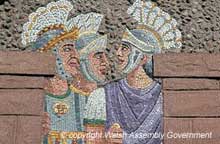
The first Roman invasion took place across the River Dee.
It was aimed at dividing the people of the highlands of Wales from the highlands of the north of what would later become England.
The campaign of AD 48 brought about the submission of the Deceangli in North Wales. In the following year, the Romans sought to divide the people of Wales from those of south western Britain by establishing major fortresses at Gloucester and Usk. They realised that to conquer Britain they had to cut off the various tribes from each other and deal with them indivudually.
The Roman advance was hindered by the resistance of the Silurians in South East Wales, under the leadership of Caratacus (Caradog), a prince of the Catuvellauni of Essex exiled by the Romans.
Caratacus moved north to fight the Romans in Anglesey and Caernarfon. He was defeated and his family were captured, though Caratacus himself fled to the Brigantes.
The Brigantes queen, Cartamandua, betrayed him to the Romans. He was taken in chains to Rome, where he asked, "Why do you, with all these grand possessions, still covet our poor huts?" He died in Rome in 54 AD.
Six years later the Romans attacked Anglesey, the stronghold of the druids, the inspirers of British resistance. According to the historian Tacitus, the legionnaires took off their clothes and swam across the Menai Straights to battle the druids.
By 75 the Silurians had been conquered and, by the AD 60s, with the defeat of the Ordovices, the whole of what would be England and Wales had come under Roman control.
Roman authority
The Romans divided their new province Britannia into a civilian lowland zone and a highland military zone.
In the years after 70 AD, new fortresses, each capable of housing a legion of 5,600 men, were established along the Welsh borders, most notably at Chester and Caerleon.
In Wales, part of the military zone, there were at least 30 auxiliary forts linked by straight roads and situated a day's march from each other. As many as 30,000 troops were stationed in Wales where they often had to quell resistance fighting.
The forts were not all fully manned for long, as most of the people of Wales came to accept Roman rule. Particularly, in South Wales, the Silurians appear to have gradually adapted to the Roman presence and offered little trouble from the second century.
The exception seems to have been the Ordovices of the centre and the North West. In the Forum in Rome today, there is a vast mosaic map of the Roman Empire. The territory of the Ordovices is not shown as part of it.
Although there was a continued military presence in the area, the lack of remains of villas indicates that the Romans did not enjoy a peaceful ride.
This can be compared to the evidence of Roman strongholds in South East Wales. The Silurians, despite their initial challenges to Roman authority, came to adopt the settlers' habits.
Caerleon, perhaps the best place in Europe in which to appreciate the layout of a Roman fort, was not fully garrisoned until after about AD 120.
Source British Broadcasting Corporation
点击查看本频道更多精彩内容




