中国网站品牌栏目(频道)
作为莎士比亚四大喜剧之一,《无事生非》写作于1598-1599年,是莎士比亚喜剧写作最成熟的时期。剧中数条线索巧妙穿插,最吸引人的是培尼狄克和贝特丽丝的恋情。他们起初誓抱独身,相互讽嘲,各不相让,最后彼此倾倒,完满结合。相比莎士比亚其它喜剧,《无事生非》场景及语言更接近真实生活,彷佛是一般人也会发生的故事。剧情热闹欢乐,富有哲思;人物性格鲜明,妙语连珠。剧中人物探寻的则是两性关系中的自我意识以及真诚与尊重。
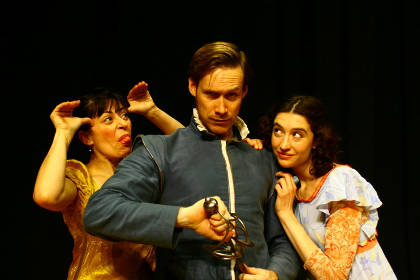
延续TNT剧院一贯戏剧与音乐相结合的艺术风格,由保罗•弗拉什作曲的《无事生非》在音乐上为莫扎特和爵士乐的混搭风格。TNT版《无事生非》节奏明快、情感跌宕、诙谐幽默、诗意隽永。他们有意规避雕琢痕迹,整场演出行云流水,呈献给观众的不是博物馆里的古董,而是历经岁月冲刷而生命力愈加旺盛的经典。《无事生非》将于近日在英国、挪威、德国、以色列、哥斯达黎加和中国演出。
北京站
时间:2011年5月13日(周五)、14日(周六)晚7:00
地点:北京大学百周年纪念讲堂观众厅
订票电话:010-65516930
拨打电话010-65516930订票,即可享受9折购买《无事生非》120、150、200元演出票折扣
其他城市演出时间:
【惠州】
时间:2011年4月15日 20:00
地点:惠州文化艺术中心
订票电话:0752-2898088, 2898080
【深圳】
时间:2011年4月16日 20:00
地点:深圳保利剧院
订票电话:0755-86371698,86371699
【东莞】
时间:2011年4月17日 20:00
地点:东莞玉兰大剧院
订票电话:0769-22837366/88/99/11
【重庆】
时间:2011年4月24日 19:30
地点:重庆大剧院
订票电话:023-61863166/88/99
【成都】
时间:2011年4月26日 19:30
地点:锦城艺术宫
订票电话:028-86650834, 86653820
【泰州】
时间:2011年4月28日 19:30
地点:泰州大剧院
订票电话:0523-86150111,86151188
【杭州】
时间:2011年4月29日19:30
地点:杭州大剧院(暂定)
【上海】
时间:2011年4月30日、5月1日 19:30
地点:兰心大剧院
【武汉】
时间:2011年5月2日 19:30
地点:武汉琴台大剧院
订票电话:027-84550088转8888
【郑州】
时间:2010年5月3日 19:30
地点:河南艺术中心
订票电话:0371-69092200/18
【合肥】
时间:2011年5月5日 19:30
地点:合肥大剧院
订票电话:0551-3501222,3501888
【宁波】
时间:2011年5月6、7日 19:30
地点:宁波大剧院
【苏州】
时间:2011年5月8日 20:00
地点:苏州科技文化艺术中心
订票电话:0512-62899899
【烟台】
时间:2011年5月10日 19:30
地点:烟台大剧院
订票电话:0535-6605566,6608899
【青岛】
时间:2011年5月11日 19:30
地点:青岛大剧院
票订票电话:0532-88038099, 88038088
英国TNT剧院
创立于1980年,是世界级国际巡演剧团,曾获得慕尼黑双年艺术节、爱丁堡戏剧节、德黑兰艺术节大奖和新加坡政府奖等多项大奖。TNT剧院不仅在英国本土声名显赫,而且是全球巡演国家和场次最多的英语剧团——几乎占据了德国全部英语话剧市场,也是在法国、日本和俄罗斯演出最多的英语剧团。
TNT剧院倡导戏剧激发观众的想象力,让观众成为戏剧的参与者而非旁观者,致力于在戏剧中融入多种艺术形式,每个剧目都邀请顶级作曲家为其量身创作音乐,因此作品中有很重的音乐和舞蹈元素。
TNT剧院从2000年开始创作莎士比亚的系列作品,包括《哈姆雷特》、《麦克白》、《仲夏夜之梦》、《罗密欧与朱丽叶》和《驯悍记》等,迄今已在全球30多个国家演出1000余场。
Much Ado About Nothing China Tour
Beijing
13 May (Fri), 14 May (Sat), 2011-04-11
Venue: Peking University
Shanghai
Date: 30 April(Sat), 01 May(Sun) , 2011
Venue: Shanghai Lyceum Theatre
The China Tour of TNT Theatre UK is presented by Milky Way Arts & Communications Co. Ltd
Much Ado About Nothing throws down a challenge to the audience with its very title. What is this play? A comedy that is not always funny? A tragedy with a happy ending? A thriller even? Or is it a masque: that strange mix between symbolic drama and dance theatre that was to overwhelm English theatre a few years after Shakespeare’s death. I think the answer is yes to all these questions – MUCH ADO ABOUT NOTHING defies categorisation but at the same time it reveals Shakespeare’s genius. We are used to thinking that tragedy is more profound than comedy, but Shakespeare balanced the comic with the tragic, he knew that profoundest truths are often revealed through laughter – which is a human emotion than no animal can express – whereas sorrow is not so unique.
Shakespeare knew that tragedy is enhanced by comedy and vica versa. It is perhaps that presence of comedy in his tragedies that takes them to the peak of human achievement; for surely the gravedigger in HAMLET, the Fool in KING LEAR and the Porter in MACBETH are essential to these iconic masterpieces. The later Shakespeare abandons tragedy altogether, surely believing that tragic-comedy is the most perfect mirror of the human condition. MUCH ADO ABOUT NOTHING is part of a long tradition of dark English humour that starts with Chaucer and continues to this day – Dickens, Wilde, Charlie Chaplin and Beckett all contributed to the genre and Beckett’s famous line: “Fail, try again, fail better” is clearly related to the glorious title of MUCH ADO ABOUT NOTHING. Love and life are never darker than when they are held to be nothing.
Our approach to the play is to try and explore its extremes, not to flatten it by making its conflicting moods and fast changing values into one harmonious whole. This is a baroque masterpiece not a social documentary or romantic comedy. Shakespeare alerts us to this with his setting (or lack of it). It seems Don Pedro is Spanish, Claudio is Italian, while Dogberry and maybe Beatrice are clearly English. Hero seems to be lifted from the classics and to behave as such, (that is from the poems of “Hero and Leander” etc). There is a battle but no one gets hurt. There is an evil villain but he disappears half way through the play.
There are whole scenes where nothing actually happens – such as the brilliant scene where Dogberry’s Watch fail to tell Leonato of the evil plot. So our approach has been to let all these elements co-exist as Shakespeare probably intended. We have not sunk to the easy director’s trick of setting the play in a consistent time and place – why is this so popular? This play is clearly not set anywhere. We accept this in Baroque painting why not in theatre? And here is a key – the classical world offered the Baroque artist an alternative universe. So our approach is to embrace the baroque, with all its exaggerations and super-realism. This allows the play to breathe (we feel) and allows us to be grotesque – a key word for TNT theatre – and we think for Shakespeare. Besides, the Baroque was entertainment, a release from Christian art and a lot of fun. This is a comedy where the audience is supposed to laugh.
Surveillance, tricks, deceits and lies are not just part of the fabric of Messina (as they are in Elsinore) – they are relished. They are almost the only way that this society works. Nothing can be believed that is not first overheard. Nothing is real unless it is discovered by spying. What is spoken openly is usually a lie or a trick. Even the “good” figures inhabit this world and relish its conventions: for example Hero and the Friar. This is not an accident or a game, it is how Messina functions. It therefore seems to us that this secretive and deceitful behaviour must be heightened and dramatised. In doing so we try to expose the folly that Shakespeare was aiming at with his dark comedy.
MUCH ADO ABOUT NOTHING is a claustrophobic drama. Beatrice is the great rebel, a woman who openly speaks her mind in a (corrupt) man’s world and expects to be left on the shelf for her pains. Her greatest moment is her command to Benedick to “kill Claudio”. Because at that instant she sees through the pretence and asks in two plain words for justice in an unjust land. Benedick has to change, not so much because he responds to Beatrice as a lover but because he responds to Beatrice as a rebel who insists on plain truth and justice. When he denies his old bachelor self little is at stake, but when he challenges his old friend to a duel to the death the stakes are high and the denial of his former self far greater. But Shakespeare twists the plot and lets Benedick off the hook. It is the stupidest of all, Dogberry and his Watchmen, who unravel the evil and bring justice. Harmony prevails and even Don John is caught and punished. Has anything been learnt or was it all truly Much Ado About Nothing? This is the glory of Shakespeare’s great comedies: it is for the audience to decide. Tragedies have closure (or catharsis). These dark comedies touch us because they resonate and ask us if all our petty cares and self-deceptions are much ado about very little.
(英国使馆文化教育处提供)
 |
 |
 |
 |
 |
 |